What Is MAGI-2? Sand.ai’s 480B AI Video Model, Explained
MAGI-2 is the newest video model from Sand.ai. This guide covers who made it, what it can do, how it differs from MAGI-2 Preview, whether it is open source and where you can use it.
By Nano Banana · Updated · 6 min read
Who makes MAGI-2, and when did it come out?
Sand.ai makes MAGI-2. Sand.ai launched MAGI-2 on November 24, 2026 (Sand.ai). MAGI-2 is the third model in Sand.ai’s MAGI video line. Sand.ai released MAGI-1 with open weights on April 21, 2025 (GitHub). Sand.ai released MAGI-2 Preview, a smaller research version, on August 5, 2026 (Sand.ai).
| Model | Released | Size | Source |
|---|---|---|---|
| MAGI-1 | April 21, 2025 | — | Technical report |
| MAGI-2 Preview | August 5, 2026 | 114B total, ~6B active | Sand.ai blog |
| MAGI-2 | November 24, 2026 | 480B total, ~28B active | Sand.ai blog |
What can the MAGI-2 video model do?
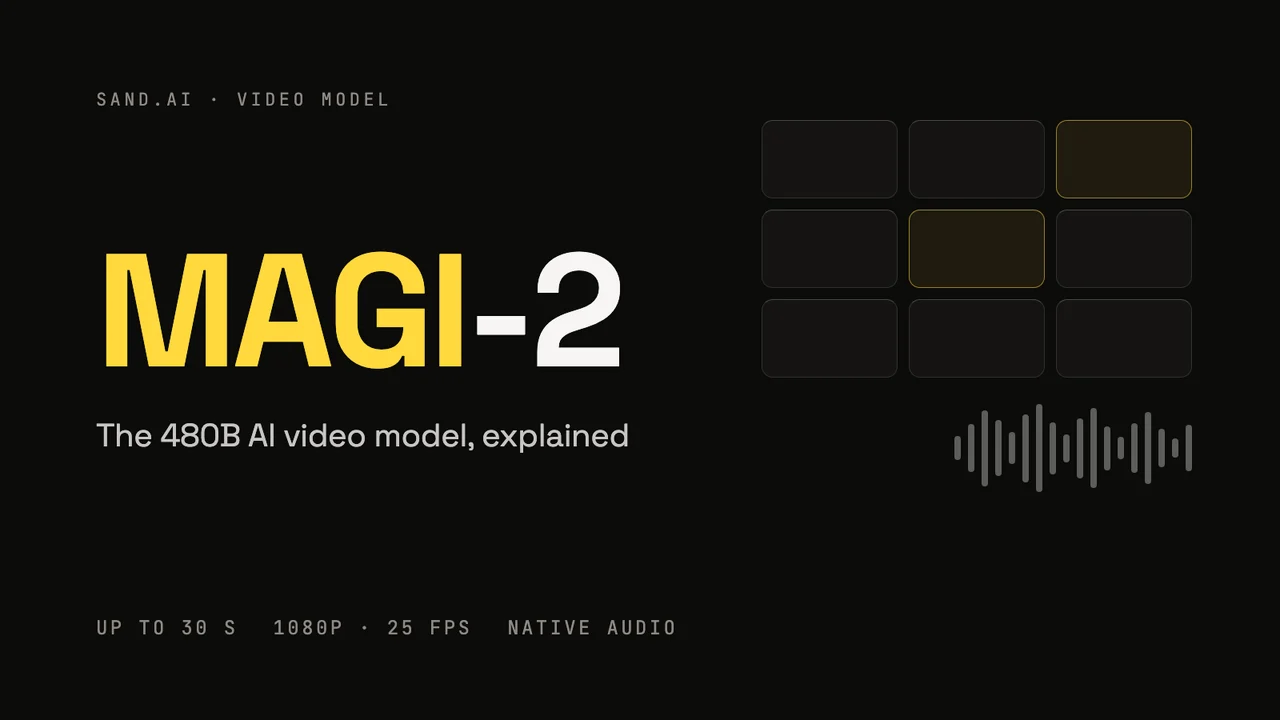
MAGI-2 generates up to 30 seconds of 1080p video at 25 frames per second, with sound, in one pass (Sand.ai). Sand.ai lists these capabilities in the launch post:
- Native audio. MAGI-2 makes picture and sound in the same model, including dialogue with lip sync, foley, ambient sound and music.
- Omni-reference. One MAGI-2 request can combine up to 20 references: up to 10 images, 5 videos and 5 audio clips.
- Timeline and shot-cut control. Sand.ai shows MAGI-2 placing cuts at set times and holding a 30-second single take.
- Video editing. MAGI-2 supports targeted edits on an existing video.
- Six aspect ratios. MAGI-2 renders 21:9, 16:9, 4:3, 1:1, 3:4 and 9:16.
What is the difference between MAGI-2 and MAGI-2 Preview?
MAGI-2 is more than four times the size of MAGI-2 Preview, and it is the version Sand.ai offers through its API and partners. MAGI-2 Preview was a research release with open code. The table lists the figures Sand.ai has published. A dash means Sand.ai has not published that figure.
| MAGI-2 | MAGI-2 Preview | |
|---|---|---|
| Released | November 24, 2026 | August 5, 2026 |
| Total parameters | 480B | ~114B |
| Active parameters | ~28B | ~6B per token |
| Pre-training data | ~4T tokens | — |
| Max length | 30 s, 1080p, 25 fps | — |
| Arena Elo (4-task average) | 1150.3 | 998.5 |
| Open weights | Promised, not yet released | Code on GitHub |
The Elo figures come from Sand.ai and use the Artificial Analysis Video Arena v2.1, averaged over four tasks: image to video and text to video, each with and without sound (Sand.ai). Sand.ai compares MAGI-2 only with MAGI-2 Preview there. The launch post does not rank MAGI-2 against Veo, Kling or Seedance.
Is MAGI-2 open source?
No, not yet. Sand.ai says it will open-source MAGI-2 and publish a technical report later, without a date (Sand.ai). The earlier MAGI-2 Preview is the version you can download today: its code is on GitHub and its weights are on Hugging Face. Running MAGI-2 Preview locally needs data-center GPUs, because the model has about 114B parameters.
Where can I use MAGI-2?
You can use MAGI-2 through Sand.ai’s own API and through apps that host it:
- Sand.ai API Platform: developers call MAGI-2 from code (platform.sand.ai).
- VidMuse: Sand.ai names VidMuse as its official partner on its home page (Sand.ai).
- Higgsfield: Higgsfield offers MAGI-2 for 30-second 1080p videos with sound (Higgsfield).
- Multi-model APIs: several API providers that bundle many video models also list MAGI-2.
You can also run MAGI-2 in the browser with the MAGI-2 video generator on nano-banana.love, which covers text to video, image to video and reference images, videos and audio.
How long does MAGI-2 take to make a video?
MAGI-2 is slow. On nano-banana.love, a MAGI-2 video usually takes 13–20 minutes, even for a 4-second clip. Faster models such as Kling 4.0 and Seedance 2.5 usually finish in a few minutes. Plan MAGI-2 for final renders you can wait for, not for quick drafts.
How does MAGI-2 compare with Kling 4.0 and Seedance 2.5?
MAGI-2, Kling 4.0 and Seedance 2.5 all make clips of up to 30 seconds with sound. MAGI-2 is the cheapest of the three at 1080p on nano-banana.love, and the slowest. The table uses each model’s settings and credit prices on this site as of November 25, 2026.
| MAGI-2 | Kling 4.0 | Seedance 2.5 | |
|---|---|---|---|
| Made by | Sand.ai | Kuaishou | ByteDance |
| Length | 4–30 s | 3–30 s | 4–30 s |
| Quality | 1080p only | 720p, 1080p | 480p, 720p, 1080p |
| Reference images | Up to 10 | Up to 10 | Up to 30 |
| Reference videos and audio | Up to 5 each | — | — |
| Sound | On or off | Always on | On or off |
| Credits per second at 1080p | 4 | 9 | 36 |
| Typical render | 13–20 minutes | A few minutes | A few minutes |
- Pick MAGI-2 for final 1080p videos with sound when price matters more than speed, or to copy the movement from a reference video.
- Pick Kling 4.0 when you need the video in minutes, a cheaper 720p draft, or an edit of a clip you already have.
- Pick Seedance 2.5 for 480p tests, or for scenes that need many reference images.
How do I write a good MAGI-2 prompt?
A good MAGI-2 prompt describes the action, the camera and the sound in plain English sentences. MAGI-2 prompts can be up to 8,000 characters on this site. These habits help:
- Write the beats in order (“first… then… finally…”) so a 30-second clip has enough action.
- Name the camera move: a slow push-in, a low tracking shot, an orbit.
- Put spoken lines in quotes and say who speaks them.
- End with a “Sound:” line that lists effects, ambience and music.
- Refer to uploads as @Image1, @Video1 and @Audio1, numbered in the order you added each kind.
For example: “A glassblower lifts a glowing bulb of molten glass from the furnace and slowly turns it on the pipe. The camera starts close on the glass and pulls back to reveal the workshop. Warm firelight, shallow depth of field. Sound: the roar of the furnace, crackling glass, the clink of tools.”